If you’re choosing an HVAC system, it’s easy to get pulled straight into brand debates, rebates, and “what size do I need?” But the best outcomes usually come from a calmer order of operations: understand what your home actually needs, confirm your airflow can deliver it, and then pick equipment that matches your comfort priorities and budget. HVAC is one of those upgrades where the right choice feels almost invisible, while the wrong choice can be loud, uneven, and expensive even if the unit is “high efficiency” on paper.

Start with Your Home’s Load, Layout, and Climate
Every good HVAC choice starts with the same question: how much heating and cooling does your home really need? That “load” is influenced by insulation, air leaks, windows, sun exposure, ceiling height, and even how many people and appliances are inside. Two homes with the same square footage can need very different systems.
If your contractor is sizing a new unit purely from square footage or by copying your old system’s capacity, that’s a warning sign—because old systems are often oversized, and homes change over time. If you already have comfort problems, treat those as “design inputs.” Installing new equipment on top of the same airflow problems can recreate the same complaints—just with a newer unit.
How to Choose an HVAC system: Sizing, Ductwork, and Airflow Come Before Features
When people ask how to choose an HVAC system, they often mean “Which model is best?” In reality, performance is built on fundamentals that don’t show up on a spec sheet: correct sizing, duct condition, return air, and commissioning (setup and verification after installation). The system can only be as comfortable as your air distribution allows. If ducts are leaky, undersized, crushed, or missing returns, even premium equipment may struggle with uneven temperatures and noise.
A contractor who’s planning a quality install should be able to explain, in plain language, how they will:
- Justify the system capacity (not guess it).
- Confirm the ducts can handle the airflow the equipment requires.
- Verify performance after installation (so you’re not just hoping it’s correct).
Those steps are the difference between an HVAC project that feels like an upgrade and one that feels like an ongoing experiment.
What Efficiency Really Depends On
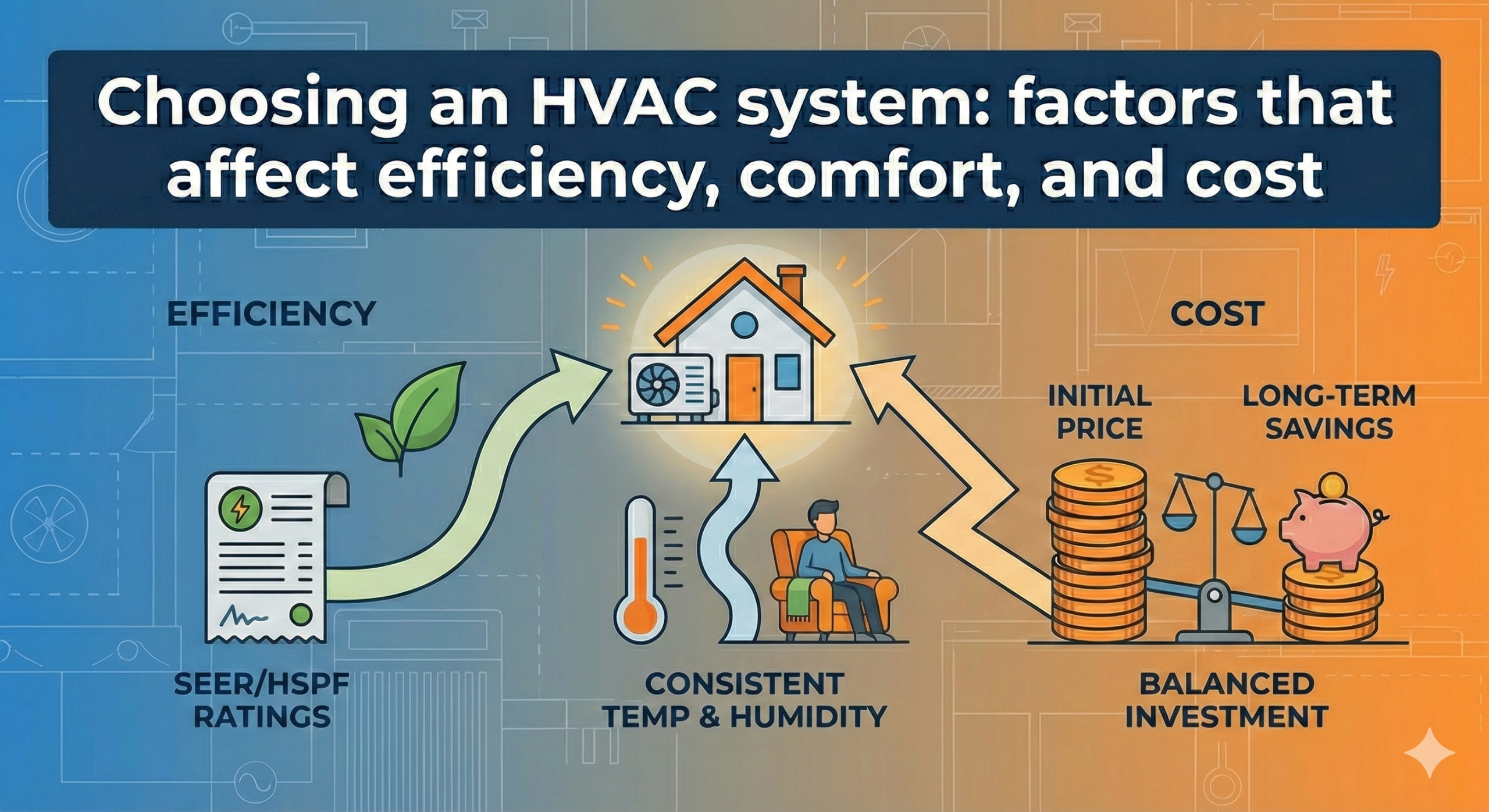
If you’re thinking and asking like help me choose an energy-efficient HVAC system, it helps to know what “efficient” actually means in real life. Efficiency isn’t only the unit’s rating—it’s also how hard the system must work in your specific house. A high-efficiency unit installed on leaky ducts or sized incorrectly may run longer than it should and deliver less comfort than expected.
The biggest efficiency drivers tend to be:
- Proper sizing that avoids constant short cycling.
- Tight ductwork (especially on the return side) so conditioned air isn’t lost.
- Correct airflow settings so the coil or heat exchanger operates in its intended range.
- A home envelope that doesn’t leak conditioned air and doesn’t pull in uncontrolled outdoor air.
- Smart control strategy that reduces waste without creating comfort swings.
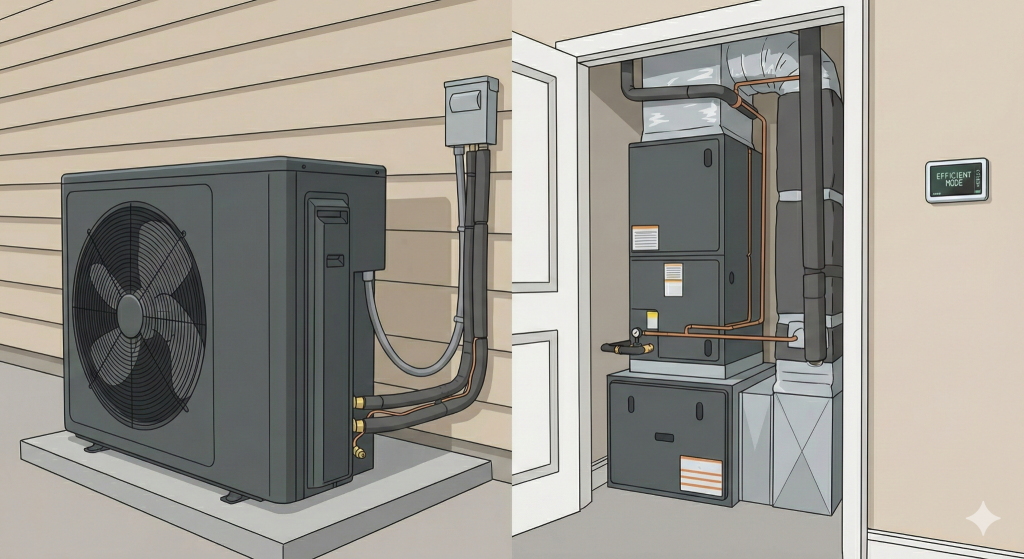
System type also matters. In many regions, modern heat pumps can deliver strong efficiency because they move heat rather than generate it. In colder climates or where fuel prices favor it, a furnace can still be a sensible choice. In some situations, dual-fuel can balance efficiency and cold-weather performance—but only when it’s configured correctly and matched to the local climate and energy costs.
Quick HVAC System Comparison: Efficiency, Comfort, Noise, Cost
When you’re narrowing options, a side-by-side comparison makes it easier to match your priorities—efficiency, humidity control, noise sensitivity, and total project scope—to the right system category.
This table won’t replace a load calculation or duct inspection, but it will help you compare “big picture” trade-offs before you get lost in model numbers:
| System option | Best for | Efficiency & comfort notes | Noise notes (what to expect) | Cost drivers / common “gotchas” |
| AC + Gas Furnace (split system) | Homes with existing gas + ducts, cold winters | Strong heating output; cooling depends heavily on coil/airflow and humidity control settings | Indoor airflow noise depends on duct sizing; outdoor unit noise depends on placement | Duct leakage and poor returns can ruin comfort; furnace venting and combustion safety matter |
| All‑electric Heat Pump (ducted) | Moderate to cold climates (with the right model), electrification goals | High efficiency potential; best comfort with variable capacity + good airflow | Often quieter indoors with variable-speed; outdoor unit placement still matters | May require electrical upgrades; performance depends on sizing and commissioning |
| Dual‑Fuel (heat pump + furnace backup) | Climates with cold snaps where gas backup is preferred | Flexible: efficient mild-weather heating via heat pump, strong backup heat when needed | Similar to ducted heat pump; switching modes should be smooth when configured correctly | More complexity = more setup risk; controls must be configured right |
| Ductless Mini‑Split (single or multi‑zone) | Homes without ducts, additions, room-by-room comfort fixes | Excellent zoning and steady comfort; great for targeted upgrades | Very quiet indoors; outdoor unit noise still depends on placement | Multi-zone design can be tricky; aesthetics and wall placement matter |
| Packaged Unit (common in some regions) | Limited indoor space, certain home layouts | Can work well, but installation quality and duct design are key | Noise can be more noticeable if close to living areas | Service access, weather exposure, and duct connections are frequent weak points |
Use this table as a question-starter: “Which option best matches my home’s layout, comfort issues, and budget?” Once you have the right category, comparing brands becomes much simpler and less stressful.
Comfort Isn’t Just Temperature: Humidity, Airflow Balance, And Controls
A comfortable home feels consistent, not just “72°F on the thermostat.” Real comfort is a blend of even room temperatures, steady cycles, and humidity that feels normal in summer and winter. This is where features can matter—but only after the fundamentals are right.
Humidity is a common pain point. If your system short cycles, it may cool quickly but remove less moisture, leaving the home feeling clammy. Equipment that can run at lower output for longer periods often improves comfort because it maintains steadier conditions. Controls matter too. A thermostat schedule that makes extreme temperature swings can push the system into loud, high-output bursts. A smarter approach is steadier setpoints and a setup that matches how you actually live in the house.
HVAC System That Minimizes Noise: Quiet Comfort Decisions That Actually Work
If you’re asking how do I choose an HVAC system that minimizes noise, focus less on marketing claims and more on what makes systems loud in the first place. Noise usually comes from high air velocity through undersized ducts, poor return air paths, vibration transfer into framing, or an outdoor unit placed where sound reflects directly into bedrooms and living spaces.
Quieter HVAC is often the result of several small choices:
- Equipment that ramps gradually (instead of blasting on at full power).
- Duct sizing and return airflow that reduce whistling and “rush” sounds.
- Proper mounting and vibration isolation so hum doesn’t travel through walls.
- Outdoor unit placement that avoids bedroom windows and echo-prone corners.
If your current system is noisy, mention exactly what kind of noise bothers you most. “It’s loud” can mean vent whoosh, rattling ductwork, startup thump, or outdoor-unit hum—and each has a different solution. The best plan is the one that targets the real source of noise, not just the equipment label.
Cost and Value: What Drives The Total Price and The Monthly Bill
The HVAC cost is more than the unit itself. Total project cost includes installation labor, permits, disposal, electrical upgrades, ductwork improvements, thermostat and controls, and the time spent verifying performance. Two quotes can look similar yet deliver very different values depending on what’s included—and what’s quietly excluded.

Monthly operating cost depends on efficiency and runtime. A leaky home or leaky ducts can force a system to run longer regardless of its rating. That’s why the cheapest install is not always the cheapest system over time.
The Fastest Way to Get The Right System The First Time
A great system starts with a contractor who treats HVAC like a designed project, not a quick swap. Strong contractors ask questions, look at ducts and returns, explain sizing, and provide clear trade-offs. They should also be able to describe how they’ll verify the final result, because “installed” isn’t the same as “performing correctly.”
A solid quote usually includes clear details such as:
- Specific equipment information.
- Why that size and system type fit your home.
- Whether duct changes are needed.
- What’s included.
- Warranty terms.
If a bid is dramatically cheaper, ask what’s missing. HVAC surprises usually come from scope gaps: duct repairs discovered late, electrical upgrades not included, or poor commissioning that leaves comfort problems unresolved.
Final Guidance: A Simple Way to Decide without Overthinking It
Start by naming your top priority: lowest monthly bill, best comfort, quiet operation, or lowest upfront cost. Then choose a contractor who addresses the foundation pieces—load sizing and airflow—before you compare features. Once the fundamentals are correct, the “best” system becomes the one that matches your climate, layout, and comfort goals with the least complexity and the most reliable performance.